



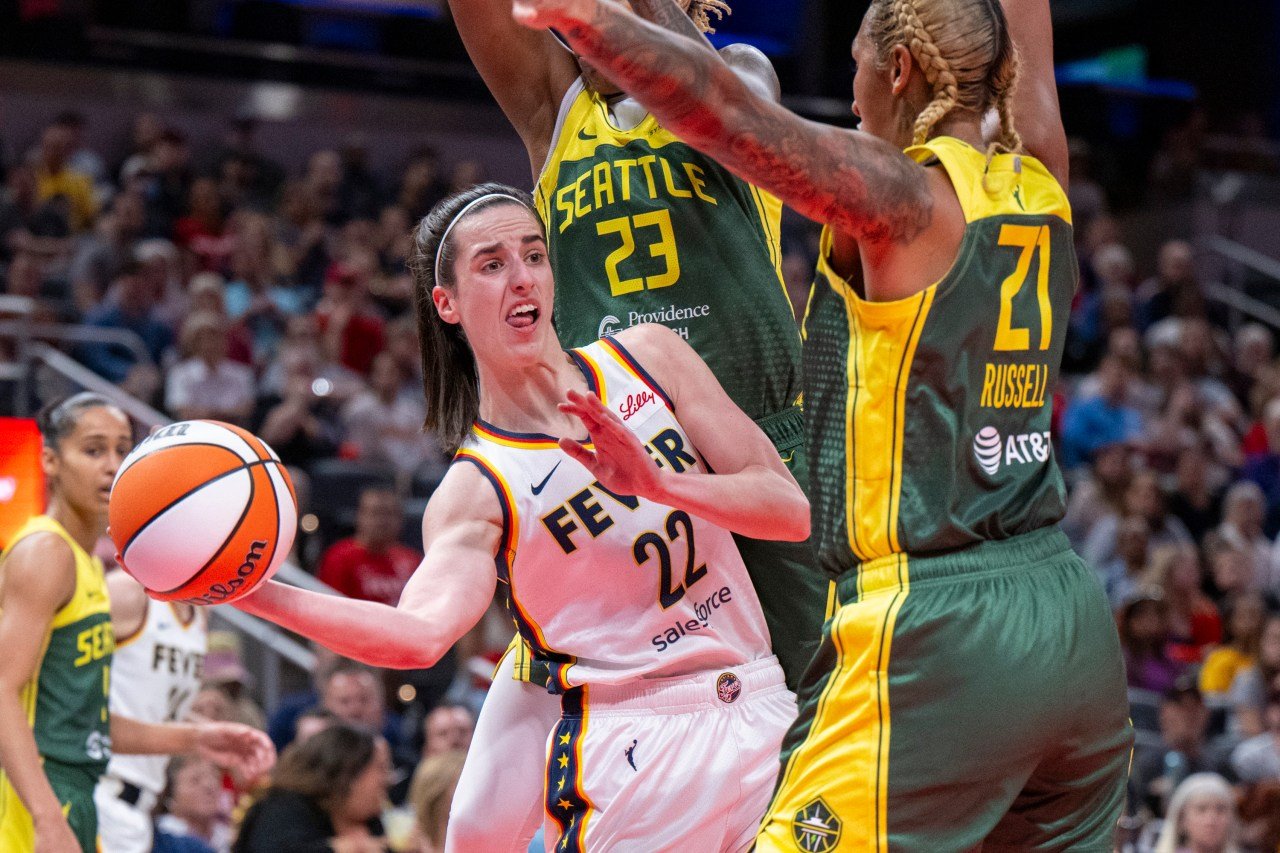
NEW YORK (AP) — Oh, you thought going to a WNBA basketball sport is likely to be an escape from the arguments and polarization which might be so widespread in American life nowadays? Ha, good one.
Among the environment within the public and media that has swirled across the skilled ladies’s league because the season began final month has been much less enjoyable time and extra tradition struggle, with rookie Caitlin Clark because the unwilling eye of the storm.
The white, 22-year-old College of Iowa school standout and No. 1 draft decide has change into a canvas for all kinds of projections in her debut season with the Indiana Fever. She, and the predominantly Black and brown ladies enjoying within the league alongside her, appear to have change into the most recent proxies for longstanding American points from race, gender and sexual orientation to who will get to take (or is thrust into) the highlight and who will get ignored.
That shouldn’t actually shock anybody, says Sarah Fields, professor of communication on the College of Colorado Denver, who research the intersection of sports activities and American tradition. “Sport,” she says, “is a microcosm (that) displays and refracts society.”
What makes Clark distinctive additionally makes her a lightning rod
That Clark deserves consideration for her basketball prowess shouldn’t be doubtful.
— She holds the report for many factors by a Division I school basketball participant, was identified for her three-point pictures together with a robust passing capacity, and led her staff to 2 straight nationwide championship video games. (They did find yourself shedding each, to LSU and the College of South Carolina.)
— She was the unquestioned best choice for the 2024 WNBA draft in a robust class that additionally included Angel Reese of LSU, Kamilla Cardoso of South Carolina and Cameron Brink of Stanford College.
— Clark has additionally had the fortune of getting into the scene at a time when ladies’s sports activities, at each the collegiate {and professional} ranges, are seeing growing curiosity and engagement from the general public. The sponsorship cash began coming for her in school, thanks to call, picture and likeness alternatives, and he or she only recently signed a signature sneaker cope with Nike.
However that is America, the place individuals who could have been flying underneath the radar or are identified solely to a smaller group can garner widespread public consideration and movie star nearly in a single day, and abruptly everybody’s bought ideas and opinions to supply.
In some corners of the web and amongst a number of the (predominantly male) sports activities punditocracy, Clark is being talked about as if she is THE motive the almost-30-year-old WNBA is FINALLY attention-grabbing sufficient to observe, and that the opposite gamers ought to maintain that in thoughts and principally be “good” to her, as if she must be protected.
{That a} younger white girl is being put within the central function, with Black and brown ladies relegated to supporting characters, is about as previous and acquainted a trope as exists in a rustic with as troubled a racial historical past as america, says Frederick Gooding, Jr., an affiliate professor of African American research at Texas Christian College.
“It’s not a lot concerning the visibility of Clark,” he says. “It additionally speaks to the invisibility of Black females and the way tough it’s for Black females to acquire that very same sort” of consideration.
Bypassing Clark for the US Olympic staff induced a backlash
There’s been chatter that the veterans of the league are merely jealous of her highlight, that she’s unfairly bearing the brunt of overly bodily play like when Chennedy Carter of the Chicago Sky knocked her down, which was later deemed a flagrant foul. Tough performs in opposition to different gamers, like when Reese was clotheslined by Alyssa Thomas of the Connecticut Solar, doesn’t get almost the identical consideration.
When Clark wasn’t picked final week for the U.S. ladies’s Olympic basketball staff as a rookie, the outrage was vocal from some, who chastised the transfer as being short-sighted for not seeing the advertising and marketing alternative.
“How dare you make this determination?” sports activities commentator Stephen A. Smith requested on ESPN’s “First Take.” “It’s silly.”
Among the commentary, particularly on-line, was overtly racial, taking the stance that Clark was being discriminated in opposition to within the WNBA and within the Olympics choice as a result of she is white and most of the different gamers are Black. (There are white gamers on the Olympics roster, a veteran squad searching for its eighth straight Olympic gold in opposition to powerful worldwide competitors.)
On the flip aspect, there are critiques that the deal with Clark is partly BECAUSE she’s white — that in a rustic as riven by racial tensions as america, it’s one other instance of how Black ladies are ignored or stereotyped, despite the fact that they constructed the sports activities league by which she is now among the many most acknowledged names.
That WNBA groups are actually utilizing chartered flights as an alternative of economic ones comes after years of advocacy from gamers, however the timing of the league’s announcement this season was taken by some as a mirrored image on Clark’s presence.
“It’s like, OK, can we discuss concerning the many years that Black ladies within the sport have been advocating for these and never simply say that it’s about this one white girl on this one second now? As a result of it’s not,” says Letisha Engracia Cardoso Brown, an assistant professor of sociology on the College of Cincinnati. “Particularly in a sport that’s dominated by ladies of colour, by LGBTQ+ people as nicely, to type of middle our consideration on this straight white girl is simply — I imply, it’s par for the course.”
Clark simply needs to speak basketball
To be clear, none of this was began and even inspired by Clark, who has tried to maintain her public commentary to the sport itself. Requested about it final week, she initially stated: “Folks can discuss what they need to discuss, create conversations about no matter it’s. However for myself, I’m simply right here to play basketball.”
However with out referring to her by identify, WNBA participant DiJonai Carrington of the Connecticut Solar, who’s Black, then questioned in a social media put up the way it could possibly be acceptable to not communicate out about it.
“How one cannot be bothered by their identify getting used to justify racism, bigotry, misogyny, xenophobia, homophobia & the intersectionalities of all of them is nuts,” she stated, including: “All of us have a platform. All of us have a voice & all of them maintain weight. Silence is a luxurious.”
Clark gave a stronger response later that very same day, saying it was “disappointing” and “not acceptable” that folks can be utilizing her to advertise their very own agendas involving racism and sexism.
“This league is the league I grew up admiring and desirous to be part of. Among the ladies on this league have been my largest idols and function fashions rising up,” she stated. “Treating each single girl on this league with the identical quantity of respect is a primary human factor that everyone ought to do.”
As a fan of ladies’s basketball, Naomi Oberman-Breindel, 36, of Manhattan, needs to see that change into the case.
“There are numerous unbelievable basketball gamers with actually attention-grabbing and compelling tales — as gamers and as individuals,” she wrote in an electronic mail. “What is going on proper now appears like a compelled monoculture with a singular deal with one individual.”
Shut Modal
Recommend a Correction
Recommend a Correction
